VIDEOS
A selection of studio recordings, interviews, and short videos documenting the context and thinking behind painting.

Declarations
Gesture and touch unfold in immediate contact with the figure and the material.
2025 — No Words and No Letters (declaration video)
A declaration of painting as physical encounter.
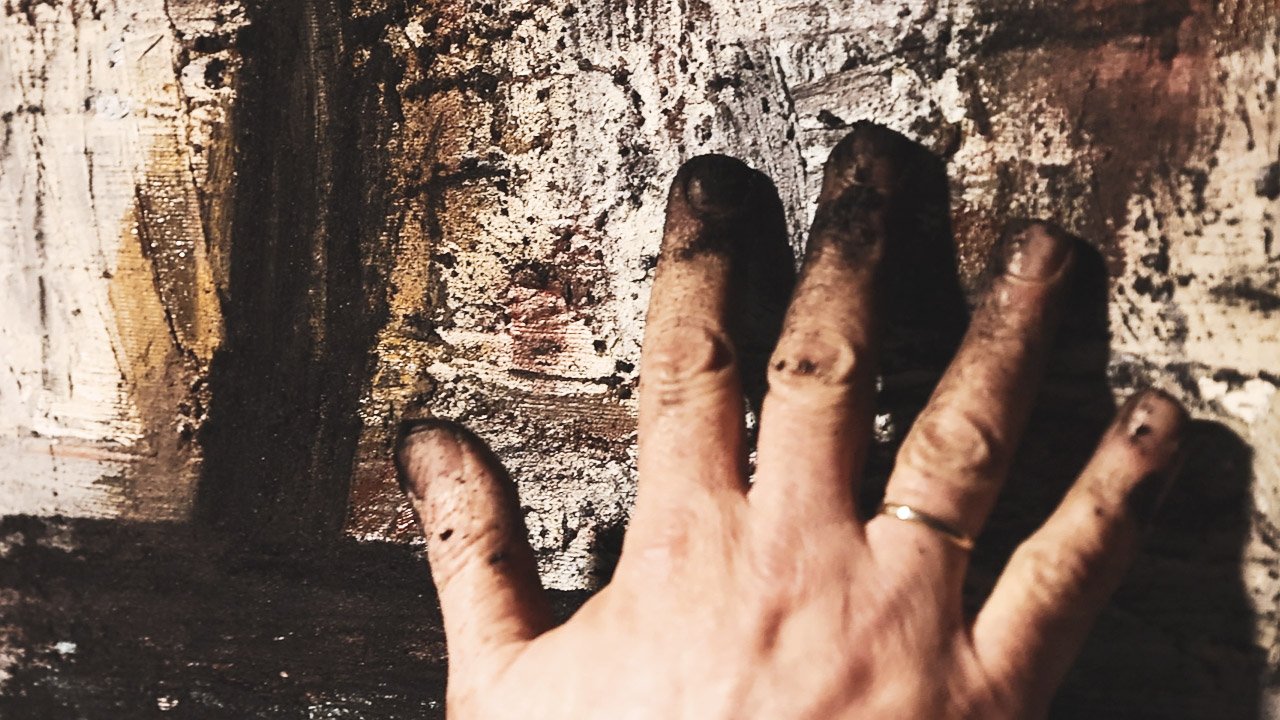
Close views of carving, dragging, dropping, and force. Sounds of painting. Marks formed through impact and gravity. Rough and smooth zones collide, with the acoustics revealing the intensity of the act as opposing forces merge into a single, coherent moment of making.
Filmed in 2025 at the Nyolcésfél Inspiration Zone & Creative Space, Budapest. | Visuals by A-TeamAgency | Sound design by Péter Király.
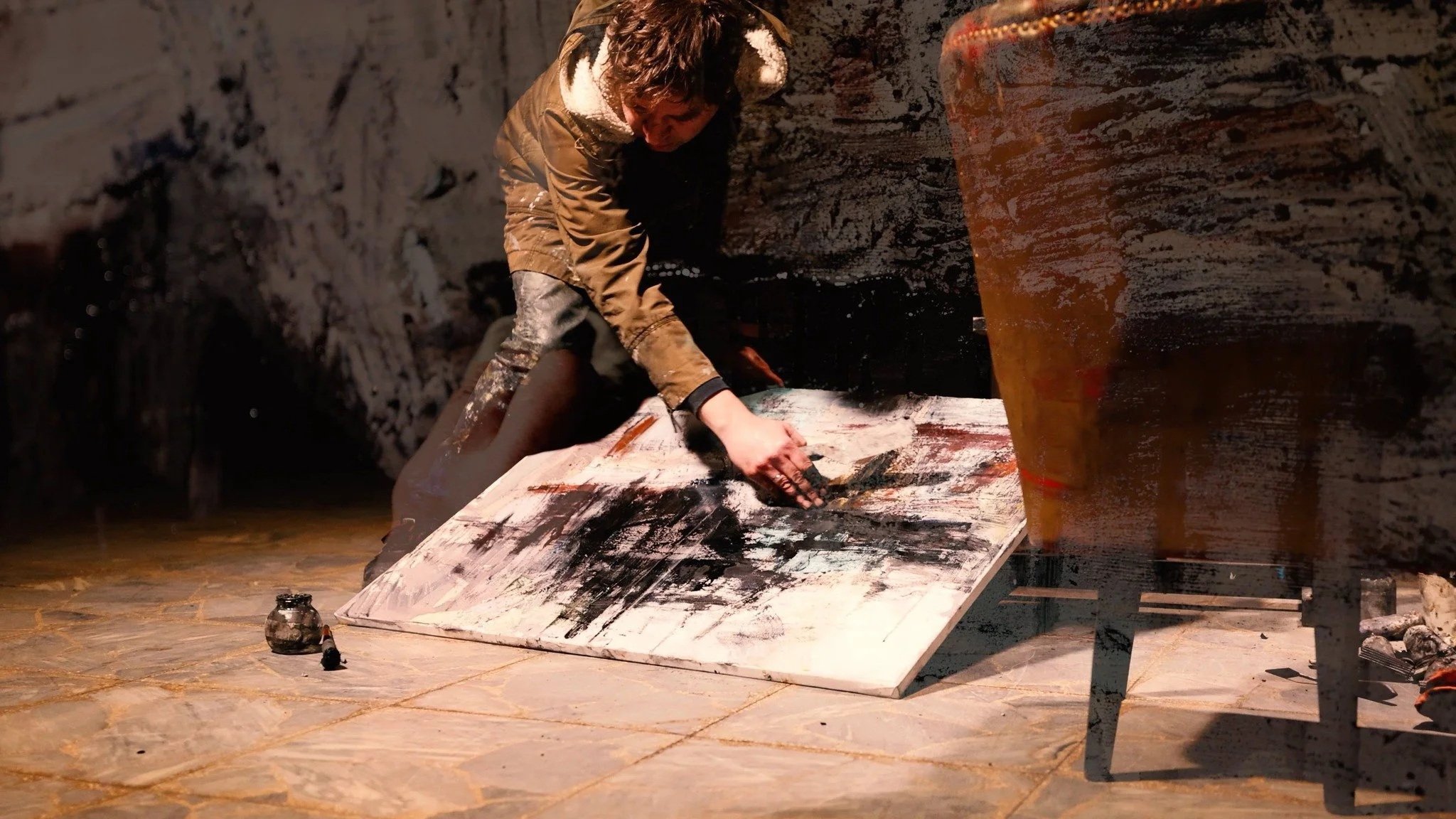
2022 — No Words and No Letters (declaration video)
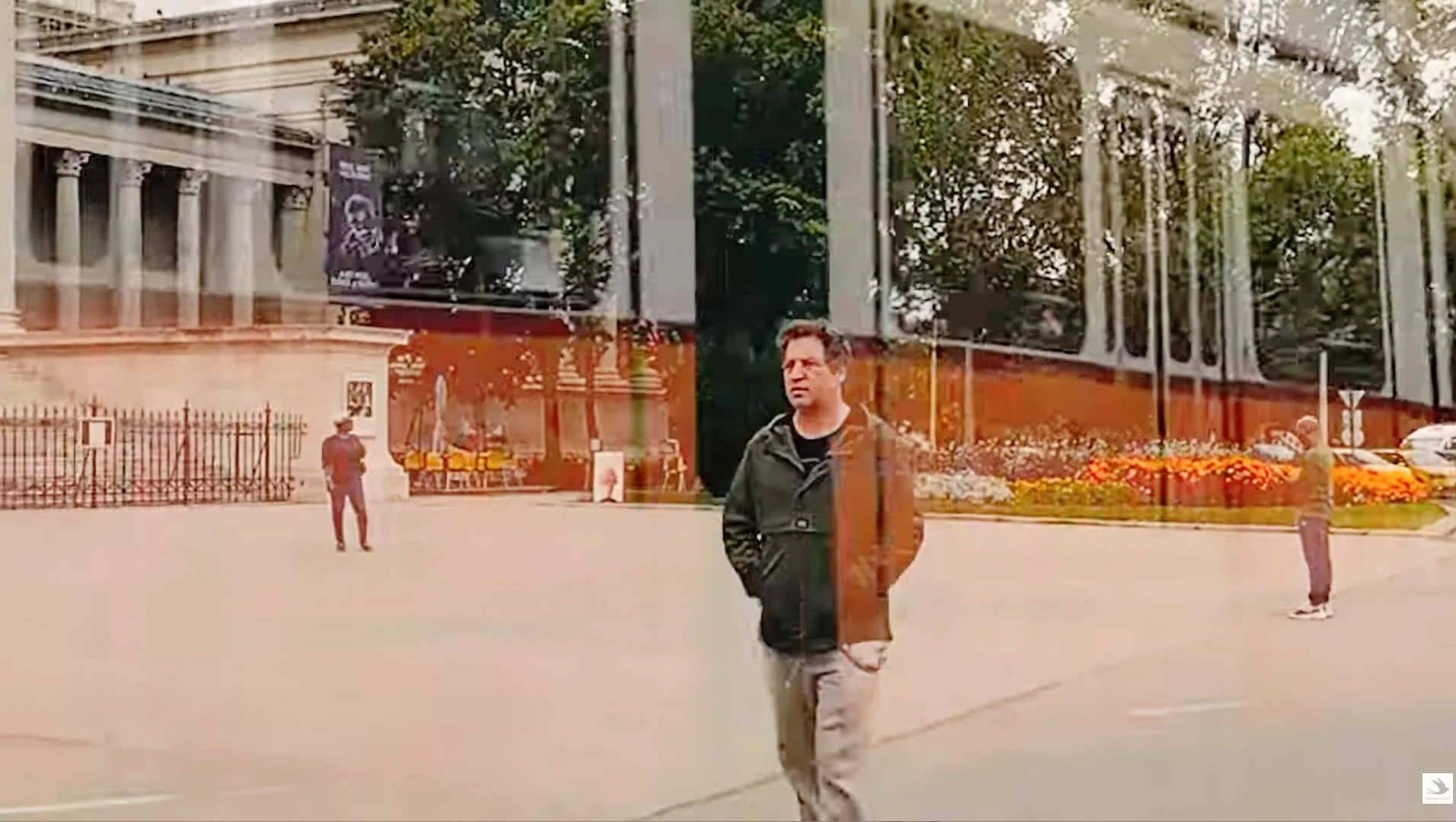
This video captures an intimate exchange between figure, gesture, and surface. Brush, hand, and material move in close dialogue as the painted and the real body mirror one another, revealing how perception and memory merge into a single moment.
Recorded in January 2022 by @ganzerbrospictures, the footage shows Tibor Simon-Mazula and his wife, Diána, working together in the studio.
Source: Ganzer Bros Pictures (2022).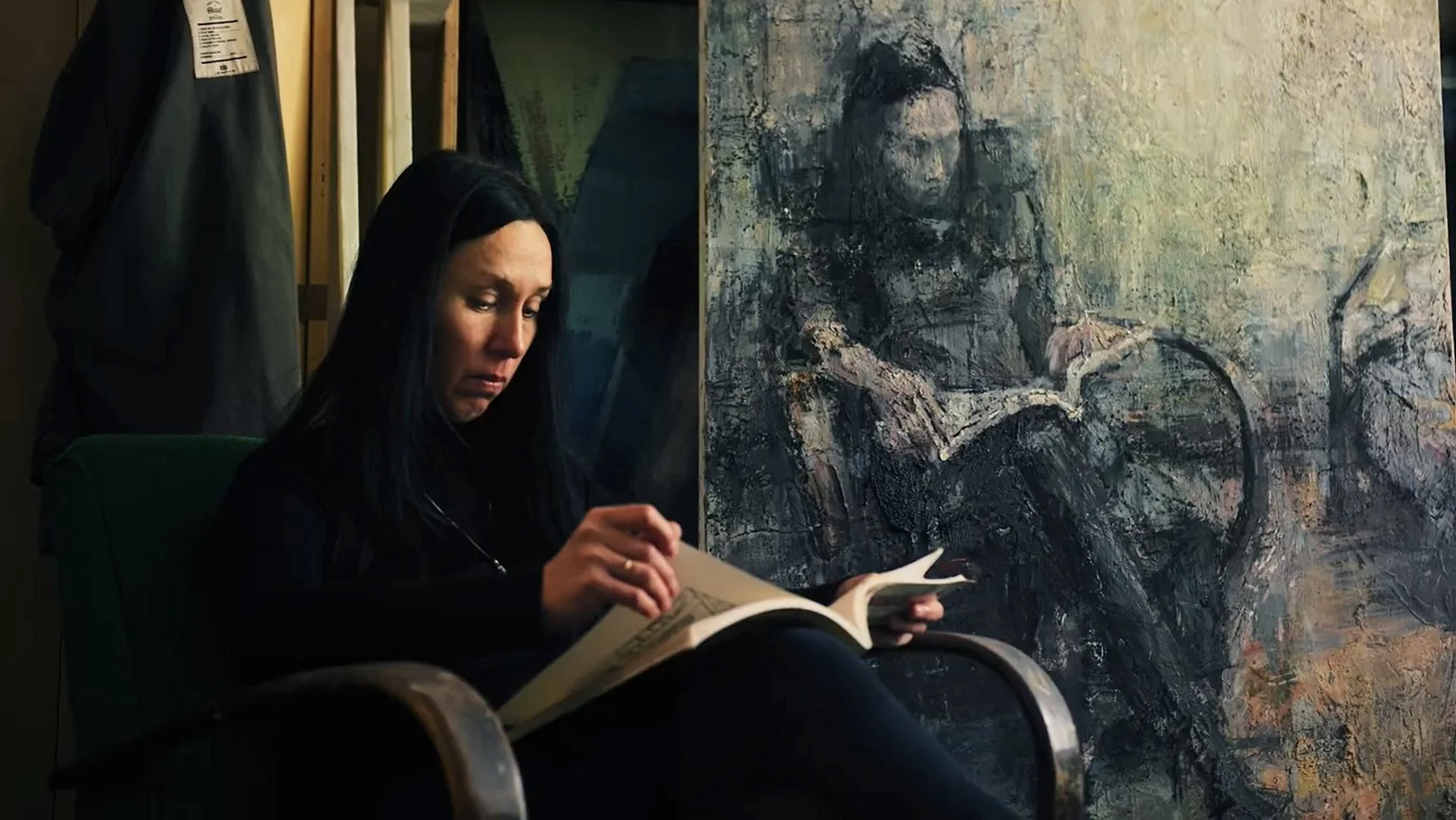
-
Artist’s Reflection
Over the past decade, my work has centered on four recurring themes—engagement, awakening, remembering, and beauty. These paintings emerge from intimate experiences: people close to me, spaces I inhabited, and situations that shaped my understanding of human connection. I continue to look beneath the visible, toward motivations and relationships that surface only through the act of painting.
As Jenny E. Balisle (San Francisco–based curator, writer, and professor) observed in 2019:
“…artworks highlight internal hope and conflict. The physicality of the painting process offers refuge while exposing the scars of experience. Bone ash literally engulfs the compositions of everyday fragments. Ancestors spoke this language, and today the translation evolves.”— Tibor Simon-Mazula, 09.15.2023
Interviews
Conversations reflecting on painting, perception, and the conditions of making.
What Art Does Mean to You?
Video presented in Seoul, 2024.
In this short video, the artist reflects on how harmony and beauty must be created by the painter in a world that is inherently imperfect. He considers art as a force capable of uniting and dissolving antagonisms, revealing the richness of ideas within an otherwise conflicted reality.
Source: Seoul Art Now (2024).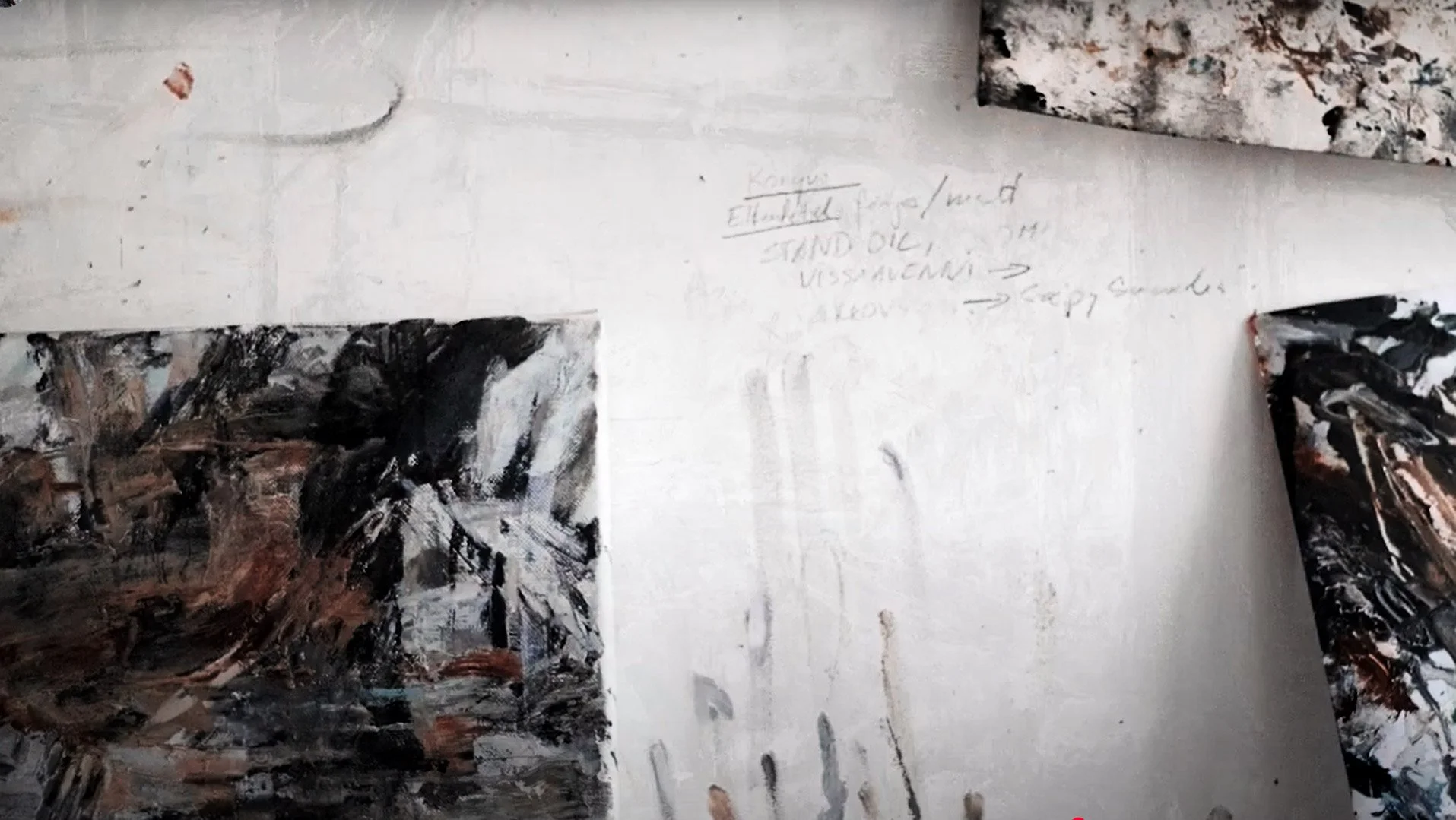
-
“The world we live in is imperfect and one of the tasks of art is to show people harmony and beauty. I rather see it as that this imperfect planet — that we have to live on with all its beauties and tragedies — is a faulty place, where one of the roles of art is to correct the mistakes of the non-ideal world.
There are so many other things that could be mentioned. Just one more example; I believe, another important aspect is that art is able to help us understand the richness of the world, the multiplicity of ideas manifesting in an almost incomprehensibly complicated multitude of phenomena.
Our world is full of antagonisms and in my view, art has the ability to unite and to dissolve them at the same time; and this is what I am trying to capture in my works. Art gives the guidance to respond to these questions.”
— Tibor Simon-Mazula, 09. 15. 2024
Why Are You So Obsessed with Capturing Silence?
Video presented in Seoul, 2025.
A short meditation on silence as a natural state — its rhythm, clarity, and resistance to noise. The artist reflects on stillness as a counterpoint to overstimulation, and on painting as an act that seeks equilibrium rather than volume.
Source: Seoul Art Now (2025).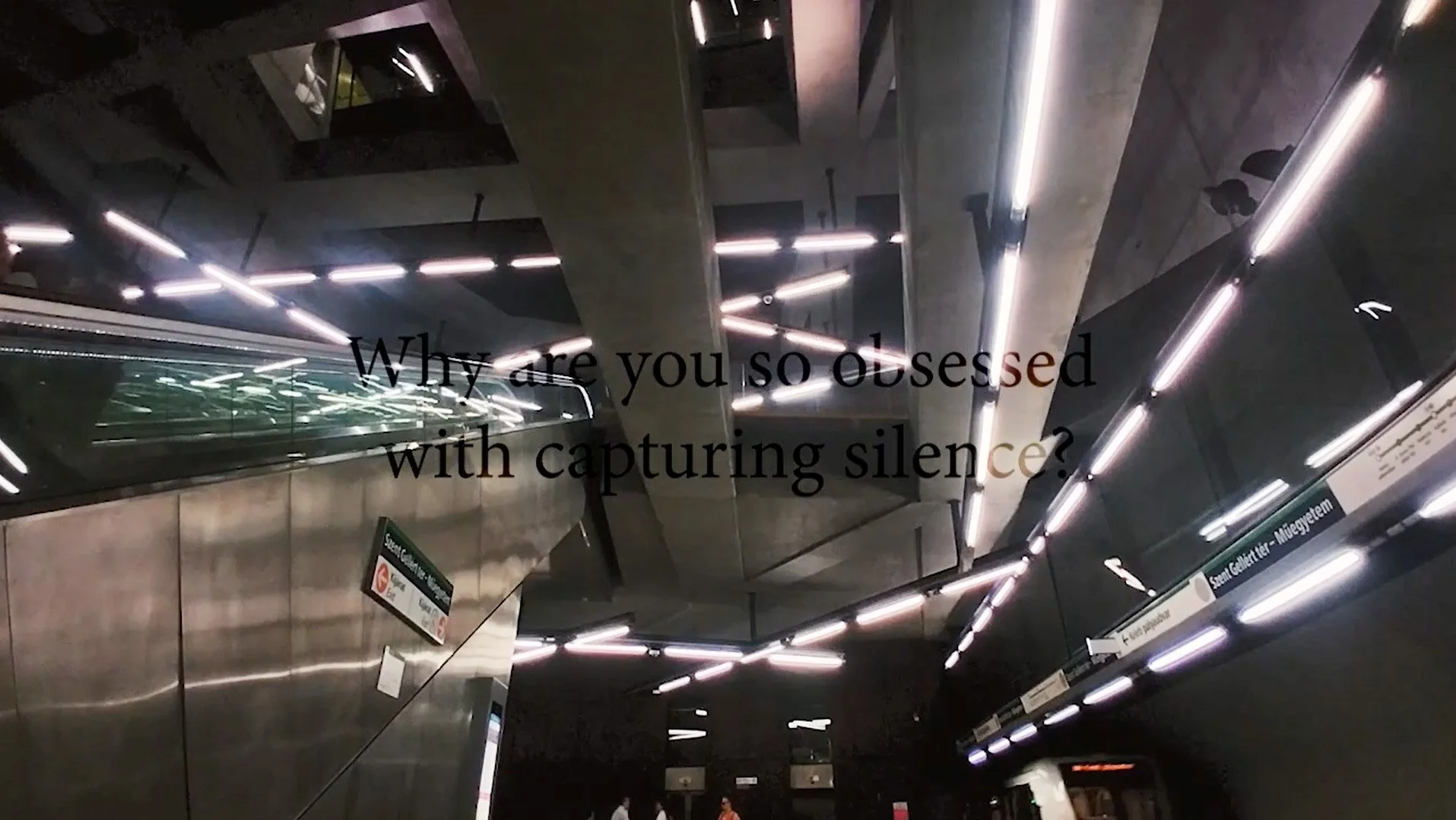
-
“I think we live in a world where it's important to emphasize silence, to highlight silence. I think silence is normal, not constant noise. The result of cacophony is that you can't hear anything because one thing cancels out the other. And what I want to show you is that even if this may be the case and I'm not judging it, but it's not normal. It is silence that is normal.
Poems are not words thrown on top of each other they are pauses, syllables, rhythms. In the same way, in the picture there are reassurances, there are highlights. So silence is very important. I rebel against noise, and I don't want to rattle and flap around and draw attention to myself loudly, but I want to rebel against the noise that's all around us, that prevents us from hearing clearly, or seeing the other.
I don't think silence is important because then there is no sound or nothing happens, but because silence is as much a part of sound as sound itself. I do not wish to drown the viewer in stimuli with my images. I want to give them a little strength, a little reassurance, a little nourishment, I don't want to shock them.
So I think that for me, it is essential that I'm rebelling for silence.”
— Tibor Simon-Mazula, 09. 15. 2025
What Made You Become a Painter?
Video presented in Seoul, 2024.
A brief reflection on finding a personal voice through painting — where gesture becomes language and instinct meets refinement. The artist speaks about the direct, tactile relationship between hand, surface, and material, and how painting balances spontaneity with learned precision.
Source: Seoul Art Now (2024).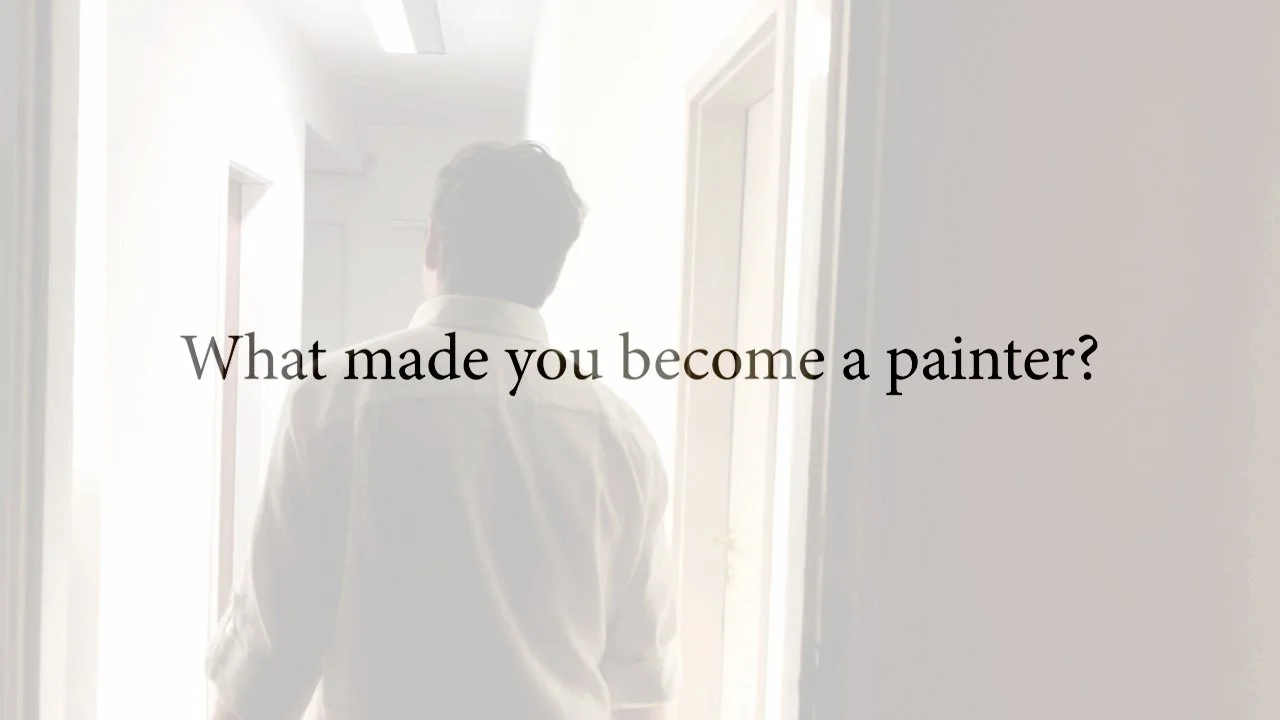
-
“Even at a young age, I felt that I had something important to say. It became a compulsion, a drive. Painting had always been there and that's where I found my 'voice'.
There are so many things about painting that make me feel that this is my path. I am fascinated by colors and shapes. Among the reasons why I became a painter I may also mention my desire to look for harmony, or to depict chaos. On the other hand, the way I paint, there's a direct contact between the surface, the material and me. The canvas and the brush are like instruments, sometimes I use my fingers or paint with my hands. Painting has this elemental, primitive characteristic that I adore.
At the same time, I love another extremity of painting. It requires a lot of learning and practice; it can be highly sophisticated and subtle. It's fascinating that the trained and the primordial practices meet. For me, painting is where I found myself and I feel I can speak to other people through it.
Painting is soothing, and the next moment it is pure energy and dynamism. Ultimately, we can say, it's a spontaneous improvisational performance that simply freezes, solidifies, and the viewer sees only its result. It has its heights and peaks.”
— Tibor Simon-Mazula, 09. 15. 2024
Interview for M2 Petőfi TV — Studio Portrait
A quiet glimpse into the artist’s working world: figures grounded in geometric structure, colour unfolding in calibrated transitions, and meaning emerging slowly as gesture and memory settle into the image.
Interview by Edit Decsi for Nézzünk Szét (Look Around), the cultural magazine of M2 Petőfi TV. | Aired July 15, 2023. | Created by Edit Decsi, Gábor Bolega, and István Frányó · Budapest, Hungary.
Source: M2 Petőfi TV-
Tibor S-M:
Most of my paintings depict a person, a figure. This is a very important aspect of my work; it is a conscious decision to portray people within their environment. I want to speak to people in the sense that they can relate to the image through the figure. My wife, Diána, is my muse, and she is the main character in most of my paintings. (00:25)Edit D:
Tibor Simon-Mazula’s paintings focus on movement and the captured moment. The focal point is not placed exactly in the center, but always positioned deliberately. (00:34)Tibor S-M:
When I begin a painting, I construct the image. There is always a geometric foundation. I compose it. In a classical or traditional sense, I start with a black-and-white drawing. I lay down the structure first, then the colors, and finally build up the texture. Here, you can see the architecture of the image; the geometry is carefully considered. There is a certain regularity to it, even if the gesture and brushwork are much looser. (01:06)Edit D:
Tibor likes to experiment with materials. He mixes pumice or bone ash into the oil paint to achieve the rough, plaster-like surfaces characteristic of his work. (01:17)Tibor S-M:
This is not a digital image. For me, material is fundamental to painting. In some areas the paint is thick, standing out, rough; in others, like here, it becomes very thin, fine, even transparent. In this section, for example, the canvas shows through. (01:42)(Music)
Tibor S-M:
Layering is present both in technique and in meaning. A painting does not communicate directly. All these small — or not so small — details (laughs), such as color, suggest this. The remarkable thing about painting is that we can perceive it all at once, and yet, over time, the painting does not change, but it continues to reveal itself. Painting is connected to time. The layers unfold gradually. (02:16)(Music)
Tibor S-M:
For almost a year now, I have been preparing for my solo exhibition in Taiwan, which has a title and a concept that unifies all the paintings. The theme is rising, awakening, or revival. I refer to this partly through symbols, but mostly through color. Recently, people have noticed that my work has become more colorful than it used to be. (02:45)Edit D:
Is there a final brushstroke for a painter? Is it possible to truly finish a painting, or do you simply stop? (02:51)Tibor S-M:
Painters often say that you have to know when to stop. It’s something you must learn. But I don’t entirely agree. I think that if you continue working, of course there is a risk of ruining the painting, but over time it can become a new work — I would say a more mature one, though not necessarily “better,” because that is difficult to define in art. So I don’t think you can ever truly end a painting by saying, “now it’s finished.” (03:30)
Interview for M5 Channel — Artist Portrait
A brief television portrait tracing the artist’s years in San Francisco and subsequent return to Hungary. The focus rests on personal trajectory rather than studio practice.
Broadcast on M5 — the educational and cultural channel of MTVA. | Recorded on October 29, 2017.
Source: M5 Channel (2017).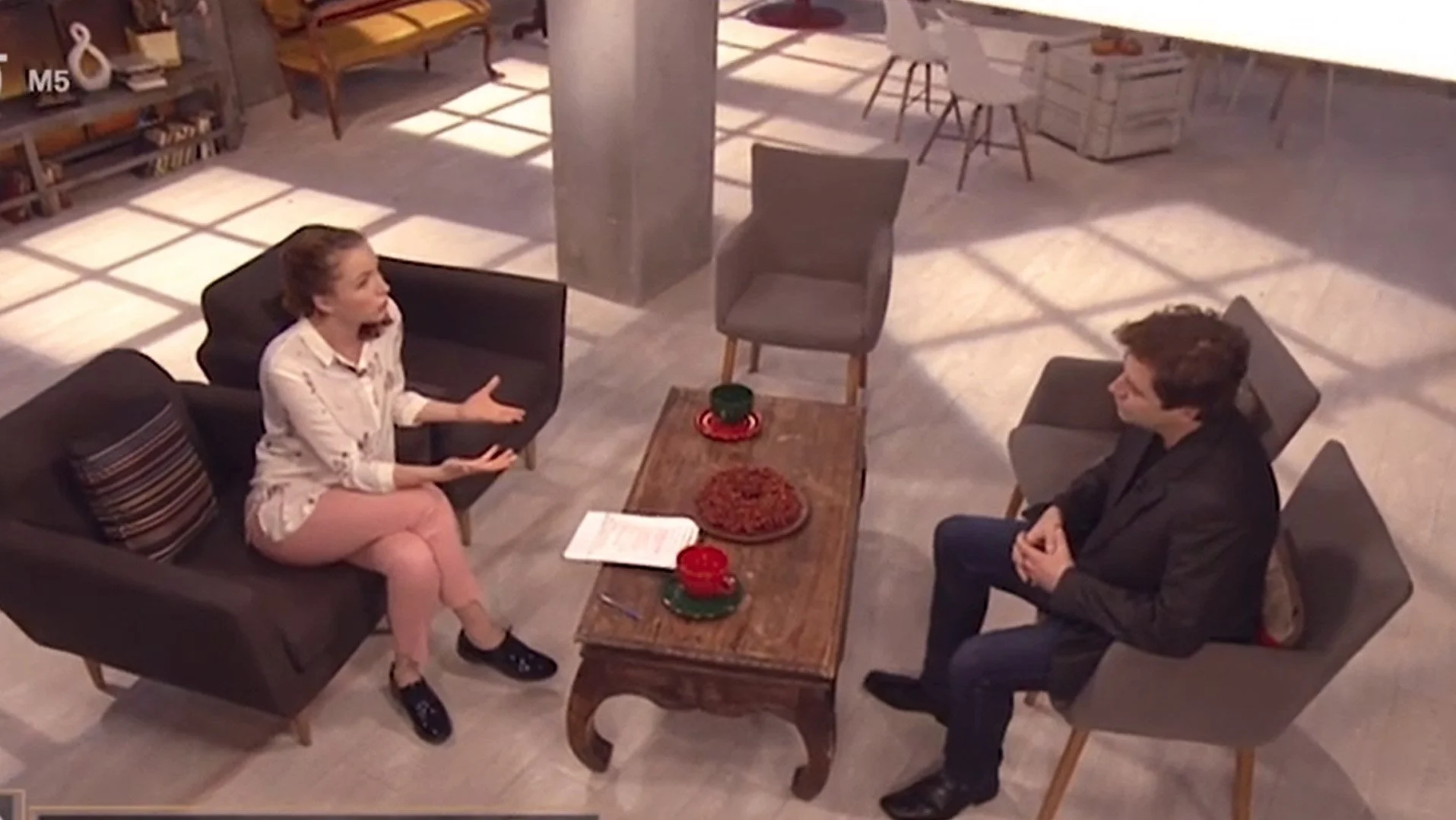
Pure Beauty — Interview for TV7
A Hungarian-language interview about the Pure Beauty exhibition at the Munkácsy Mihály Museum. This segment from TV7’s Művészbejáró presents a conversation between Tibor Simon-Mazula and curator–art historian Hajnalka Ván. The piece introduces the exhibition’s concept, selected works, and curatorial insights, accompanied by installation footage from the museum.
Source: TV7 (2019).
Seriously Cool — Artist Talk at the Munkácsy Mihály Museum (2016)
A Hungarian-language artist talk within the 2016 season of Komolyan lazulós (Seriously Cool). Filmed on January 15, 2016, in the Jankay Room of the Jankay–Kolozsváry–Tevan Collection, this conversation features Tibor Simon-Mazula in dialogue with artist Baji Miklós Zoltán (BMZ). The discussion spans painting, filmmaking, and music, reflecting on the artist’s multidisciplinary practice.
Source: Munkácsy Mihály Museum (2016).Exhibitions
Documentations of solo exhibitions and presented works within curated spatial contexts.
Culture & Art TV — Artist Feature
A feature produced jointly by Art&Culture TV, Seoul Art Now, and the Liszt Institute – Hungarian Cultural Center Seoul. The segment places Simon-Mazula’s work within the institute’s contemporary art programme and concludes with an extended presentation of his 2024 solo exhibition.
Source: Culture & Art TV · Director J Seong-hyeon.Artist Feature — Hann Art Agency (2023)
A concise feature within Hann Art Agency’s contemporary painting series.
This episode highlights Simon-Mazula’s exploration of human presence and relational space. Quick, intuitive brushwork and partially veiled figures evoke the tempo and ambiguity of urban experience, while maintaining a refined, contemporary visual clarity.
Source: Hann Art Agency (2023).About Where did she go
A 2023 solo exhibition feature, Hann Art Gallery, Tainan.
A meditation on absence rendered visible: objects remain where a figure is no longer present, creating a quiet tension between presence and disappearance. Warm and cool tones press against one another, while a slight movement — a curtain lifted by air — links interior and exterior space.
Source: Hann Art Gallery, Tainan (2023).-
“The central element of this image is absence There are many things that can be said about this image, it can have many meanings, but one of the key aspects is scarcity. It's quite clear that there is no character here, but at the same time the objects that can be associated with the figure, with a person, are present, so in fact the character is present, even though she or he is not depicted, not articulated in the painting. That's the first layer of sense, another important one is related to colours.
I'm attracted to the colour of blue. In most of my paintings, the blue is more prominent, the blue dominates the picture. Not on this one. These really powerful yellows, oranges and reds are coming forward, almost into the foreground. I'd also say that they are aggressively pushing forward compared to me; and that's one of the reasons why I worked a lot, struggled with this image, and I had to get to a point where ... finally, the image started to paint itself. And that point was, when I realized that I had to define orange, yellow and red as the opposite of blue. I got that they are complementary to each other. And then, the picture was solved for me, I was able to move on.
This strong tension between ”there is” and ”there is not”, between the cold and the warm moves the image. And as you can see, the wind blowing the curtain, there's a movement, a subtle movement and this motion connects the inner space with the outer space. The outer space is cold and the inner space is warm. I could say that the movement— the breeze permeates the area. It goes through the room from which the figure is missing. But the person is not missing because props and objects of a human being are there.”
—Tibor Simon-Mazula, 2023
About If I can only remember
A 2023 solo exhibition feature, Hann Art Gallery, Tainan.
A single turning moment held in suspension. Blurred and sharp zones, charcoal marks, and calibrated transitions articulate a figure caught between states. The painting reflects on memory, change, and the way significant shifts in life often unfold in an instant.
Source: Hann Art Gallery, Tainan (2023).-
“This painting has a pair among my paintings, but this one is a more dynamic and active image. It's about memory, movement and the significance of a moment. (00:28)
The title of my current body of work is about rebirth and awakening; both concepts are related to change. I've found that the important things in life, the big turns, the meaningful events, happen in the blink of an eye, within a very short period of time and are not the result of something planned. (01:01)
And for me, that's how this painting is connected to rebirth, to change. It captures a moment and a memory. The figure is in motion, the background is blurred, the corresponding warm and cold colors harmonize and float the figure that is moving. She doesn't walk, she doesn't sit, she doesn't stand up, she just turns around. (01:31)
I may have succeeded in depicting this in the movement of her feet, the movement of her hands, the movement of her head. These show that the character is in an intermediate state. the space is unclear and the figure is somewhat blurred, but certain parts of it are sharp. (01:56)
I used charcoal here as well, and oil paint. The use of materials in this picture is perhaps the most subtle and sophisticated. I was aiming for nice transitions. I sometimes break up these transitions with strong brushstrokes, ivory black, mars black, or charcoal. (02:22)
These brushstrokes come to me almost instinctively. At the same time, this painting, like the others, has been designed, planned and thought-out in advance. And yet, the process of creation, the expressive experience of painting, always drove my work forward. (3:43)”
—Tibor Simon-Mazula, November 2023
About We were there
A 2023 solo exhibition feature, Hann Art Gallery, Tainan.
A still life opened into light. Color takes precedence over object — a luminous field shaped by broken forms, simplified shapes, and a Parisian after-image. Minimal elements and a swirl of hues evoke the clarity of a day beginning.
Source: Hann Art Gallery, Tainan (2023).-
“This is a kind-of offbeat picture. It's part of the series, it fits, but it's also a bit out of place. (0:11)
This is a still life mainly about colour. It has a short background story. It was created after we got back from Paris, and I was impressed by the artworks I saw there. I believe that the paintings of Edouard Vuillard and Pierre Bonnard subconsciously influenced and inspired this work. But this was not at all a conscious decision to me. The way the colours burst forth, the way the shapes are broken down, and simplified, I think in some way that is the effect of Paris. (0:46)
My intention was to make a simple still life which is not quite conventional because of the size and the setting. You can't say it's a still life that fits in a line, yet, the main subject is the table. However, you don't see many things on it. There are only a few apples and a glass because I didn't want to overload the table with objects. What is important here is the swirl of colours, the cavalcade of colours that come out of nowhere and still seem real! For me at least, that was a very important idea. (1:33)
This image fits right into the arise, or rebirth sequence as it celebrates light. This could be a spring morning, a spring daybreak moment, when something starts, our day begins. It welcomes the season. That's the mood, that's the feeling I wanted to convey and interestingly enough, there was this kind of juxtaposition of Vuillard and Bonnard's images entered into my painting unconsciously.(2:12)
I love this picture, it puts me in a good mood.”
—Tibor Simon-Mazula, November 2023
Video for ART TAIPEI 2023 — by Hann Art Agency
A 2023 exhibition feature.
This video introduces Simon-Mazula’s approach to color, texture, and gesture as interdependent forces. Smooth and rough zones, harmony and disruption, presence and absence coexist within a single visual field, reflecting the artist’s interest in reconciling opposing elements.
Source: Hann Art Agency · ART TAIPEI 2023.-
“Painting has a lot of faces. I work with the texture like a little kid, it's an engaging free play! The surface on some zones is even, but elsewhere it is undeveloped. Areas respond to each other. They talk among themselves and also communicate with the viewer. (0:58)
Our world is full of antagonisms and in my view, art has the ability to unite and to dissolve them at the same time and this is what I am trying to capture in my works. This is what I try to do in my paintings, where the smooth and the rough surfaces, the beauty and the ugliness can fit together. They all complement each other. Silence and sound, nothing and something. Opposing poles merge and harmonize in art. (1:44)
So, I don't necessarily see dealing with beauty and harmony as the only purpose of Art, even though both phenomena are essential in my practice. I rather see it as that this imperfect planet — that we have to live on with all its beauties and tragedies — is a faulty place, where one of the roles of art is to correct the mistakes of the non-ideal world. And art has the power to help because “this idea about art” can be applied to everyone, not only artists. (2:30)
For me, this is one of the meanings of the Arts. But, as I said, there are so many other things that could be mentioned. Just one more example; I believe, another important aspect is that Art is able to help us understand the richness of the world, the multiplicity of ideas manifesting in an almost incomprehensibly complicated multitude of phenomena. Through Art, I can respond to this plurality. And, so too the viewer can react to it. It's not a scientific approach, it's an artistic conversation, which is a crucial way of seeing things in my opinion. (3:29)
I had been searching, I was a musician, I made short films. However, painting had always been there, and that's where I found my “voice”. There are so many things about painting that make me feel that this is my path. I am fascinated by colors and shapes. Although I often apply grays on many areas of my paintings, I consider gray not neutral as there is a lot of color in it. I am captivated by colors and I am particularly attracted to blue. (4:16)
Among the reasons why I became a painter I may also mention my desire to look for harmony, or to depict chaos. On the one hand this is why painting makes sense to me, but I also do it for other reasons. One of them is the way I paint. There's a direct contact between the surface, the material and me. The canvas and the brush are like instruments. Sometimes I paint with my finger, or with my hand. Sometimes I turn the canvas around or put it on the ground, other times I just shake it. So, painting has this elemental, primitive characteristic that I adore. (5:01)
Ultimately, we can say, it's a spontaneous improvisational performance that simply freezes, solidifies, and the viewer sees only its result. It has its heights and peaks. At times, it's focused intense work, which can be upsetting. Another time it's just calming. And the beauty of this duality is that you can't predict which phase will come next and when.”
— Tibor Simon-Mazula, 09. 15. 2023
Video by Hann Art Agency about Tibor Simon-Mazula for Art Taipei 2023 | J08 HANN ART | Hall 1 of Taipei World Trade Center, Taiwan | October 20-23
About I’ll wait and see
A 2023 solo exhibition feature, Hann Art Gallery, Tainan.
A study in stillness and geometric structure. A seated figure is anchored by measured composition, layered blues, and restrained gestures. A quiet red drapery nods to earlier pictorial traditions, offering a subtle balance between form, color, and presence.
Source: Hann Art Gallery, Tainan (2023).-
“In this picture we see a static, almost rigidly seated figure in the center. The position of the figure is especially important. It's a characteristic of all my pictures, but on this one it is perhaps more traceable than on the others, how precisely the structure of the picture is thought out geometrically. (00:37)
I'm trying to amplify the mood of the figure, the mood of this captured moment with subtle, beautiful transitions and a variety of blues. (00:51)
It's very difficult to talk about what exactly our character, the figure, the protagonist is doing, I can't put it into words, that’s why I make a painting. I want to leave room for the viewer's imagination. Pictures can be explained in some way, but I think it’s better to feel them. That's why I don't want to override the picture with words. I don't want to abrogate what our eyes see with words, and over-explain it. (01:34)
Maybe I can add that, I had an intention to refer back to the past, to the artworks of earlier ages. That's why the red drapery is in the picture, neatly laid down, not active, at rest, not blowing in the wind, not moving. It's like a prop, not a central theme, but it's the colour that makes it stand out and integrates it.(02:13)
I spent a lot of time with the face in this image, it's probably the most elaborated here. This was another huge challenge, because of what I said earlier. That it's the colours, the shapes, the gestures, the brushwork that's important, it's about the visuality of the image, and I don't want to overwhelm it with facial expressions, I don't want to over-explain it or be too literal.”
— Tibor Simon-Mazula, 09. 15. 2023
Pure Beauty — Book Launch Performance (2019)
Audio-visual performance by Zsolt Pálfalusi, presented at the Munkácsy Mihály Museum.
A darkened gallery, a single bright screen, and text appearing in real time as the performer types. Only his gestures remain visible, while the surrounding paintings recede into shadow. Without speech or music, words emerge into the light, occasionally interrupted by photographs of the artist, the muse, and the works. A restrained, improvised reflection on the relationship between image, text, and presence.
Source: Munkácsy Mihály Museum / Zsolt Pálfalusi-
Let’s assume I know nothing — not the place, not the moment, not even the man himself, only that he paints.
What is he trying to tell me?
Is that even a meaningful question???
Probably not. A painter is just a painter; an artist, simply an artist. The real question is: what sustains him???
Pure Beauty — Exhibition Feature (2019)
This video presents highlights from Pure Beauty, Tibor Simon-Mazula’s first solo exhibition at the Munkácsy Mihály Museum. The show featured approximately thirty works and remained on view for nearly two months. The segment includes interview excerpts, commentary by curator Hajnalka Ván, and installation views.
Source: CsabaTV, 2019.
Art Fairs & Galleries
Selected presentations situating the work within gallery and art fair frameworks.
ART TAIPEI 2021 — Hann Art Agency
The video offers an overview of Hann Art Agency’s booth at ART TAIPEI, featuring works by Cen Long, Alberto Alvarez, Tibor Simon-Mazula, Yasuko Hayashi, Chiu Dou, Nan Shizi Studio, Beatriz Martin Vidal, Safina Ksenia, and Li Fun-Ga. The presentation showcases a diverse selection of contemporary artworks.
Hann Art Agency · Booth D02 · ART TAIPEI 2021 | Taipei World Trade Center Exhibition Hall 1, Taiwan · October 21–25, 2021. | Note: Simon-Mazula’s exhibited work was Hot Tub (corrected title).
Source: Hann Art Agency (2021).Hann Art Agency — Taichung Art Expo 2022
This video documents Hann Art Agency’s presentation of Simon-Mazula’s drawings at Art Taichung 2022. The selection highlights the artist’s tactile mark-making and distilled approach to form within an intimate, paper-based format.
Exhibited at The Lin Hotel, Taichung, Taiwan · July 14–17, 2022.
Source: Hann Art Agency (2022).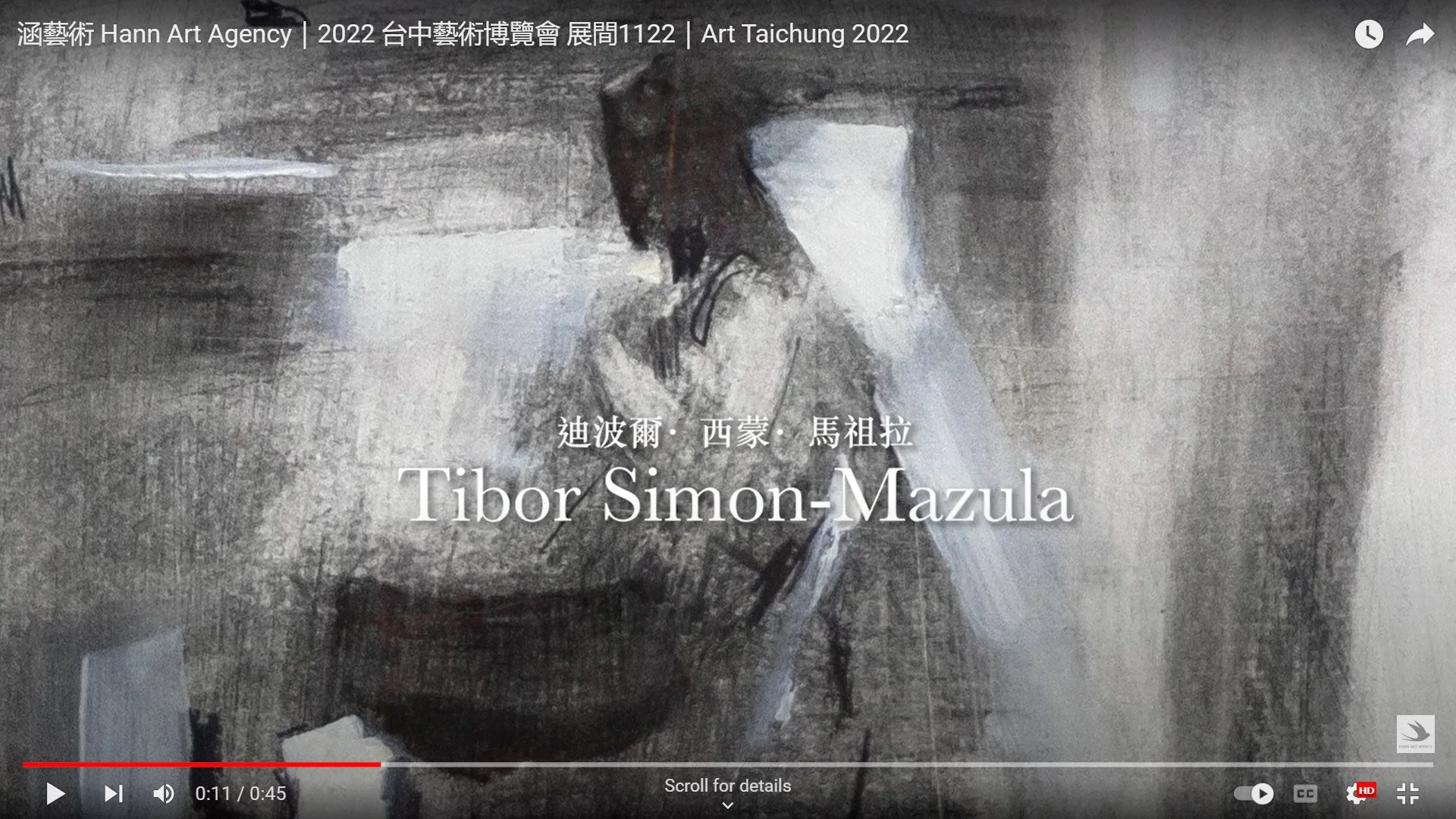
Linus Galleries — The Big Show (Los Angeles/Pasadena, California)
This video presents selected artworks featured in The Big Show, a program focused on large-scale pieces and their immersive spatial impact. The presentation contains no narration or text, only music.
Tibor Simon-Mazula is included as a Finalist in The Big Show competition video (Pasadena, CA, 2016).
Source: Linus Galleries.
Studio & Process
Studio-based recordings documenting moments of formation and live painting encounters.
San Francisco — Studio Footage by Peter Virth
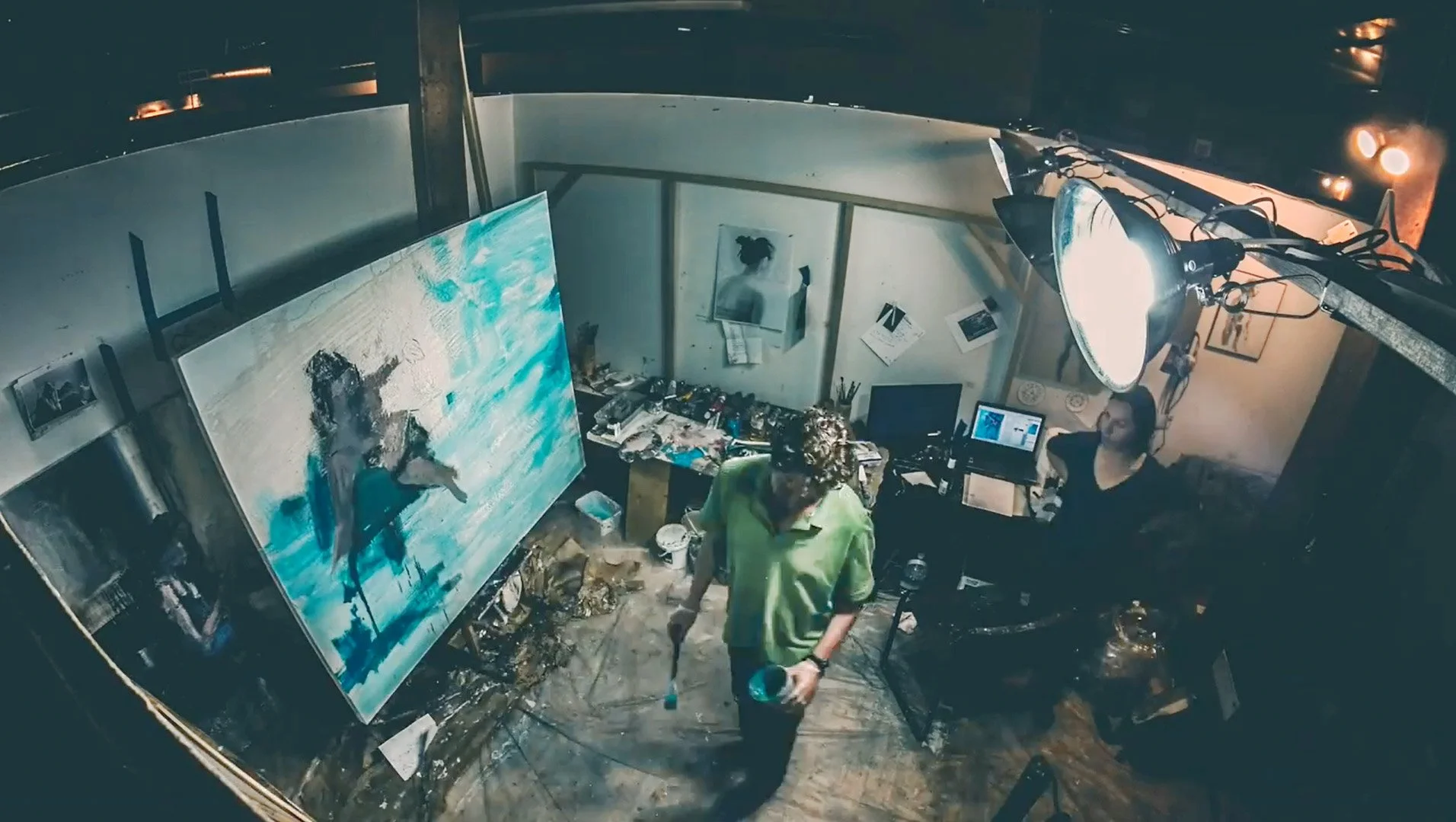
A time-lapse view from the artist’s studio at Art Explosion Studios. This uninterrupted overhead recording documents the early formation of Hot Tub No. 1 (150 × 180 cm). The footage captures the natural rhythm of the studio: shifting light, evolving surface, and spontaneous moments with Diána and Péter appearing briefly in the frame.
Filmed at Art Explosion Studios, San Francisco.
Source: Peter Virth.Live Portrait Painting Battle (2013)
Emerald Tablet Gallery, San Francisco
Archival footage of a dual portrait session with Bay Area artist Trius Fernsler.
The video records a live painting encounter with model Diána Simon-Mazula, presented without narration.
Source: Emerald Tablet Gallery.Archive
Early and archival recordings offering historical context to the artist’s practice.
Consciousness — Opening Reception (2011)
Archival footage from an early solo exhibition.
A brief document of the 2011 opening of Consciousness in the artist’s hometown. Visitors gather in the brick-walled space accompanied by live music on traditional instruments, while glimpses of the artist and Diána appear throughout.
Presented without narration, the video preserves the atmosphere of an early formative moment in Simon-Mazula’s practice.
Source: Visuals by A-TeamAgency · Original Music.Fidelity — Solo Exhibition Video
Artist Interview & Exhibition Feature
An Academy of Art University production, the film offers a distilled, modernist view of Fidelity, Tibor Simon-Mazula’s two-month solo show in downtown San Francisco.
Selected as the university’s Emerging Artist of 2013, Simon-Mazula presented paintings shaped by restraint, tension, and the quiet architecture of human presence. Curated by Serita Sangimino, the exhibition occupied the 79 New Montgomery Street Gallery from October 1 to December 1, 2013, revealing a practice where form, gesture, and lived memory are held in deliberate balance.
Source: Academy of Art University · San Francisco (2013).Playing the Drums Under Flashing Lights
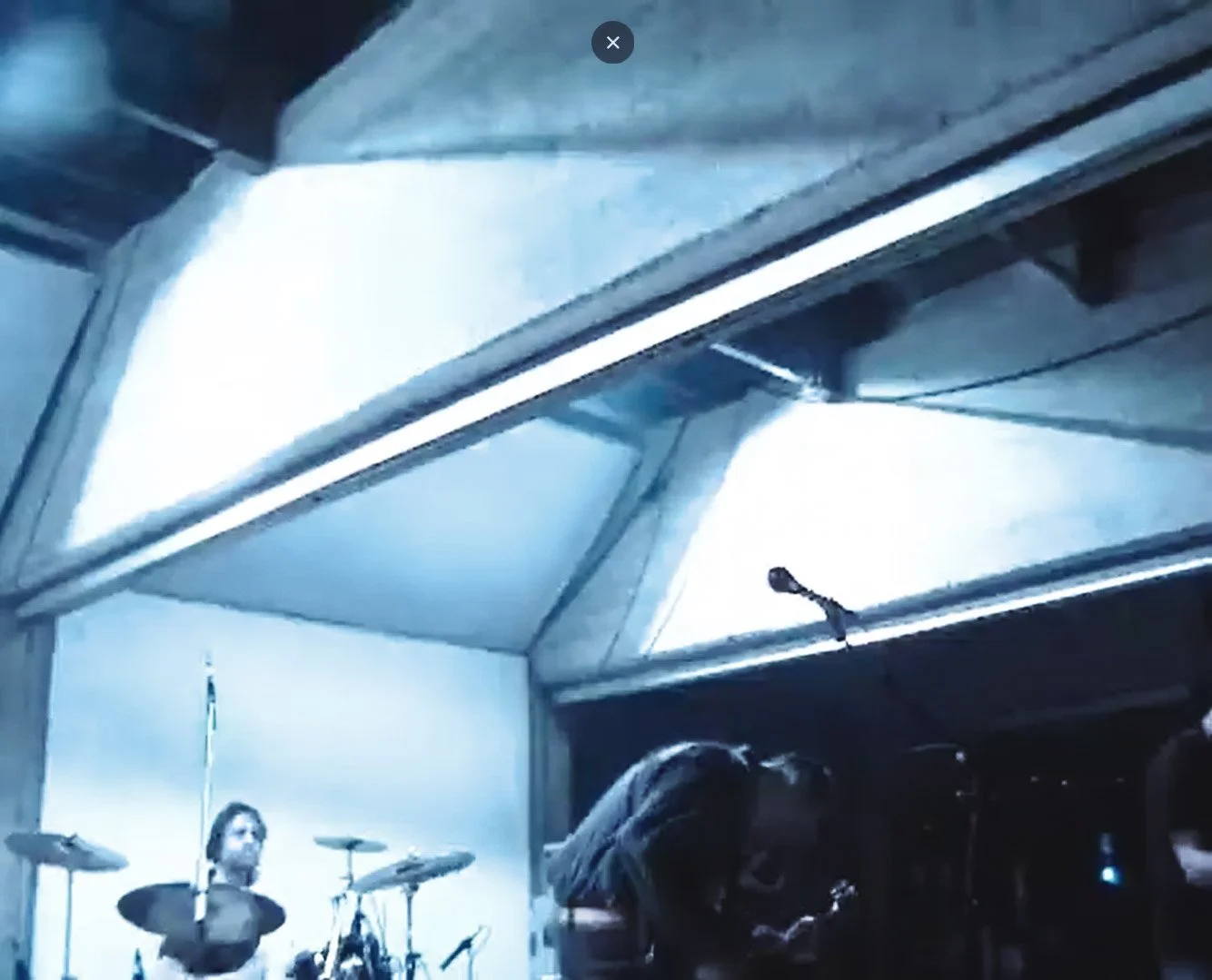
Live at Gödör Club, Budapest (2008)
Handheld footage recorded at Gödör Club, Budapest’s former underground venue.
The video captures Simon-Mazula performing on drums with Ězeknäk, a Joy Division tribute band, shortly before leaving Europe in 2008.
Band:
Krisztián Szűcs — vocals, guitar, keyboards; Geri Kovács — guitar, keyboards; Róbert Németh — bass; Tibor Simon-Mazula — drums.
Source: thecifvideo (YouTube).